Six Nations Anthems: In Full Voice

The 2026 Six Nations Championship gets underway this weekend, and before a single tackle is made or a scrum is set, the tournament’s most powerful moment arrives.
The national anthems.
Wales have made a very special announcement ahead of this year’s championship — one that speaks directly to tradition, emotion, and belief in their supporters. For the duration of the tournament, “Hen Wlad Fy Nhadau” will be delivered entirely a cappella.
No band.
No choir.
No safety net.
Just voices.
Across the Six Nations, national anthems are far more than a formality. They are a showpiece. A moment where stadium design, lighting, sound, culture, and collective identity collide. Each nation delivers its anthem differently — shaped by history, music, and crowd psychology — and together they form one of sport’s most powerful opening rituals.
Let’s take a look at how each nation delivers its anthem on rugby’s grandest European stage.
1. Wales – A Cathedral in Full Voice
Hen Wlad fy Nhadau yng Nghaerdydd ❤️
— Guinness Men's Six Nations (@SixNationsRugby) February 22, 2025
Stunning anthem from Wales!! #GuinnessM6N pic.twitter.com/J7EJXdO4n8
There is nowhere in world sport quite like Millennium Stadium when the singing begins.
Wales’ relationship with music runs deep — a nation of choirs, harmony, and communal voice. For decades, hearing Hen Wlad Fy Nhadau before kickoff has been a spine-tingling moment, capable of stopping conversations mid-sentence and raising the hairs on the back of your neck.
In recent years, Wales leaned into production:
- Lights down
- Red glow washing the bowl
- Choirs and bands reinforcing the sound
But in November 2025 against New Zealand, they tried something different.
The anthem.
Completely a cappella.
The result was extraordinary.
The stadium became a cathedral. Every word landed heavier. Every note felt personal. Players sang with pride, supporters with conviction. It was raw, emotional, and unmistakably Welsh.
That moment is now the blueprint. For the 2026 Six Nations, Wales will trust their people — confident that passion, harmony, and belief will carry the anthem every single time.
2. France – A Battle Cry in Song
On peut le dire sans exagérer : notre hymne national compte parmi les plus beaux et les plus puissants de la planète.
— Bleu Blanc Rouge ! 🇫🇷 (@LBleuBlancRouge) February 5, 2026
On est d’accord ?
🇫🇷🫶🏻🇫🇷🫶🏻🇫🇷🫶🏻🇫🇷🫶🏻🇫🇷🫶🏻🇫🇷🫶🏻🇫🇷🫶🏻🇫🇷🫶🏻🇫🇷🫶🏻🇫🇷🫶🏻
pic.twitter.com/sW5UIVeojF
Few anthems hit with the force of La Marseillaise.
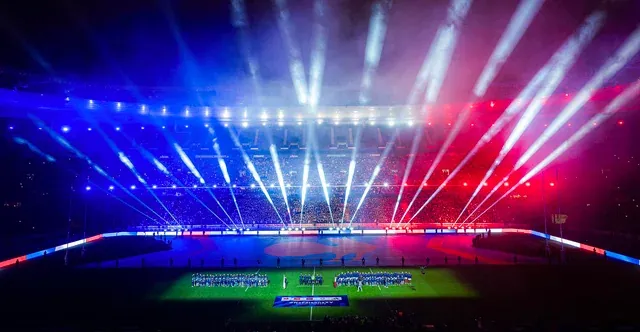
At the Stade de France, it is not sung — it is launched. A revolutionary battle cry delivered with full blood and fierce intent.
Recent presentations have leaned heavily into visual power:
- Teams locked in tight formation
- The Tricolore stretched wide behind them
- Precision lighting and stark staging
French supporters don’t harmonise — they declare. It’s aggressive, defiant, and emotionally charged. When La Marseillaise echoes around the stadium, it feels less like a song and more like a warning.
3. Scotland – Melody, Memory, and Bagpipes
Le plus bel hymne au monde ? 🌍
— Six Nations (FR) (@SixNations_FR) January 30, 2026
La magie du Flower of Scotland au Scottish Gas Murrayfield 🤩#GreatnessM6N pic.twitter.com/ZyUf1zKry0
Flower of Scotland is a different kind of anthem.
At Murrayfield Stadium, it arrives with melody rather than volume, emotion rather than aggression. There’s a natural musicality to the Scottish crowd — a rise and fall that feels almost conversational.
The defining image remains iconic:
- A lone bagpiper
- High on the stadium roof
- Sound cascading down into the bowl
In recent years, Scotland have leaned into silence too — stripping back the final lines and allowing the crowd to finish a cappella. It’s a haunting ending, often leaving opponents standing still, unsure whether to clap or simply absorb it.
4. England – Short, Sharp, and Unapologetic
🏴 God Save the King at the Allianz 🤩#GuinnessM6N #Since1883 @EnglandRugby pic.twitter.com/tGHs8K7yi5
— Guinness Men's Six Nations (@SixNationsRugby) February 7, 2026
God Save the King is brief, direct, and unmistakably English.
At Twickenham Stadium, it’s delivered with traditional pomp and ceremony and usually led by an anthem singer. Delivered by passionate, patrioticw, collective voice.
Twickenham often feels like a garden party from the stands, but down at pitch level, the sound tightens. The crowd closes in. The anthem becomes a moment of unity rather than spectacle — short, sharp, and straight to the point.
5. Ireland – One Island, One Voice
Ireland's Call in front of a sold-out crowd never gets old 😍#GuinnessM6N pic.twitter.com/hju1G1q43M
— Guinness Men's Six Nations (@SixNationsRugby) March 8, 2025
The Irish rugby team represents a united island, and its anthem reflects that complexity.
At the Aviva Stadium, Ireland’s Call is delivered with pride and purpose. It may not be a traditional national anthem, but in this setting, it works — a shared song for players and supporters from north and south.
The crowd is loud, defiant, and deeply invested. The anthem builds steadily, turning the Aviva into a wall of green before kickoff.
6. Italy – Passion on the Rise
🇮🇹 Il Canto degli Italiani 🤩#GuinnessM6N #Since1883 pic.twitter.com/Vp6NlehECY
— Guinness Men's Six Nations (@SixNationsRugby) February 22, 2026
Italy’s anthem delivery continues to evolve.
At the Stadio Olimpico, passion is never in doubt. The volume may fluctuate, but the intent doesn’t. As Italy continue to rise within the Six Nations, their anthem moments grow louder, prouder, and more confident with each season.
There’s energy here — a sense of belief that feels increasingly earned.
Final Whistle
In the Six Nations, national anthems are not background noise. They are identity. They set the emotional temperature of the match before the first collision.
And in 2026, Wales’ decision to go a cappella feels symbolic — a reminder that sometimes the most powerful production choice is no production at all.
Just voices.
Just belief.
Just rugby, in full voice.